All plants that are able to be pre-ordered will show an " on backorder" message due to the way our system works.
Products listed at bottom of page
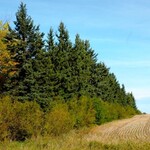
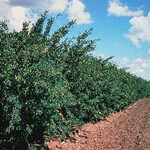
A shelterbelt or windrow is a barrier of trees and/or shrubs that
Blocks the Wind, Keeps the Snow, and Keeps the Soil
Windbreaks reduce wind speed by forcing the air currents up and over the windbreak, leaving areas of relative calm on the protected side. In Alberta, the prevailing wind comes from the northwest
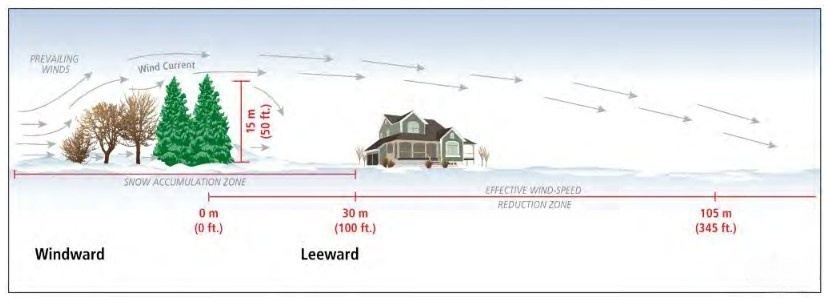
Image: Courtesy of Alberta Agriculture
Top Reasons for Planting Shelterbelts & Windrows
1) Shelterbelts create microclimates
A band of trees slows down the wind. That in turn means that heat stays around longer which in effect lengthens your growing season. A wall of spruce really makes a difference: A 20 foot wide strip on the south side of a spruce grove melts free of snow a good two to three weeks before the rest of the yard. Alternatively, on the north side, it can provide a sheltered location for delaying spring preventing sensitive buds (like Apricots) from breaking dormancy early, thus enabling them to bloom after risk of frost is past.
The area that benefits from the shelterbelt lies mainly on the leeward side of the belt. In general this protected area to the leeward is 20 times the average height of the barrier. A shelterbelt has to be continuous. If there are gaps in a windbreak weather damage is accelerated in areas lying behind the gaps. Therefore, the replacement of failures at an early age is a must.
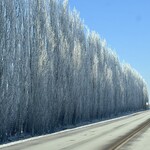
2) Shelterbelts stop the snow
Nothing like having the driveway drift in for the third time in two weeks. Many county roads have large stretches with not much in the way of trees on either side. A day of wind, and there can be 18" drifts on that stretch.
3) Lower your heat bill
If you have an older house (pre R-2000 construction style) well designed shelterbelts can put a large dent in your heating bill. This goes double for out buildings with their generally less tight construction and lower levels of insulation.
4) Save water
In fields, shelterbelts coupled with field belts (1 row of trees) can slow down the wind enough to make a serious dent in wind loss evaporation. (The wind will carry off snow moisture. The sun's action on a still day results in fine snow growing into larger crystals, less subject to direct evaporation. Liquid water moves downward through the snowpack.)
5) Lower Feed Costs
Livestock take less feed for maintenance if they can get out of the wind.
6) Habitat for beneficial birds
Most rows have a strip of unmowed grass next to them. Between the grass and the trees there are a raft of nests creating essentially zero pest issues.
6) Privacy
With the abundance of acreages, shelterbelts are an ideal way to create your own private oasis.
Additional Benefits of Shelterbelts
Properly placed field shelterbelts provide agronomic and other benefits. The main agronomic benefits include the following:
- Reduced soil erosion by wind
- Increased moisture for crop growth due to two factors: – snow trapping – reduced moisture loss through evaporation
- Potential for increased crop yields
- Reduced wind damage to crops
Other benefits:
- Provide wildlife habitat and shelter for livestock.
- Improve safety in winter travel due to reduced snow drifting.
- Lower costs of snow removal from roads.
- Beautification of the prairie landscape.
- Reduced environmental effects of agriculture by maintaining groundwater balance and protecting watersheds.
Note regarding farming
Although modern agricultural farming practices such as direct-seeding have greatly reduced the amount of wind erosion in Alberta, there continues to be some effects of wind erosion on Alberta soils each year. Eroded soils are less productive, require higher inputs for crop production and are more prone to further erosion than uneroded soils. Erosion results in damage to downwind crops, structures and buildings, requiring costly cleanup and repair. Blowing topsoil has also been cited as a concern in numerous vehicle accidents, with several resulting in personal injury. Properly designed field shelterbelts, as part of a crop management system approach, prevent or greatly reduce the risk of wind erosion.
Tips for Planting
1) Mix It UP
We can't stress this enough. Reasons for that are not just because of diversity in landscape, but also if potential diseases came through your area. It would not have the capacity to infect everything, as not all varieties are affected by pests and disease.
Use at least two different species for these reasons
- Both poplar and pine tend to drop their lower branches as they mature, spruce tend to stay wide at the bottom
- Different species have different rooting habits. By alternating them you aren't putting them in as much water stress during a dry year.
- Few pests attack trees of different families. A tent caterpillar on a poplar has a harder time reaching the next poplar if there is a spruce between. Worst case if all of the leaves are eaten off the poplar, you still have the spruce.
- Poplar grow fast. You get some results starting in about 5 years. The spruce are slower but they will outlive the poplar by 50 years. Pine aren't as fast as poplar, but they still grow a lot faster than spruce.
2) Plant more than 1 Row
Most people would consider doing 2-5 rows of trees and shrubs, with 2 being utilized in limited space areas and 5 being very thorough.
Building Your Shelterbelt
To build a Shelterbelt, you would generally choose an evergreen, such as Colorado spruce or white spruce, for one row. Then the middle row would be a fast-growing deciduous choice, such as poplar or willow. The third row is a shrub, the most poplar being a lilac, but many choices are available. If continuing to a 5 row, one would usually plant another deciduous row and a shrub row.
The idea is to make a mountain-like (pyramind) structure.
5 row layout
Shrub (outside farthest away), deciduous, evergreen, deciduous, shrub (closest to living quarters).
3 row layout evergreen
(outside farthest away) deciduous, shrub (closest to living quarters)
The evergreen row is generally on the outside of the property, farthest away from outbuildings and residences. And the shrub row is generally on the inside, closest to your buildings. If you’re doing a 5 row, you’ll have a shrub as the farthest outside row.
To figure out how many trees and shrubs you’ll need is easy. Spacing is 10 feet for trees and 3 feet for shrubs. You can find out your length in feet and crunch the numbers. For a 100 foot row, 100 divided by 10 = 10 trees needed. The spacing between rows should be about 8 feet. The further apart it is, the easier the wind will come through those areas.
Additional Considersations
Shelterbelts aren't all roses. They are a lot work to get established and can be a source of weeds. For the best possible success, consider these points.
1) Plan
The establishment of a shelterbelt requires a considerable amount of preparation in getting control over existing weeds which will compete to nutrients and resources water. The following methods may be considered alone or in tandem
- Tilling
- Chemical Control
- Utilize a plastic mulch to suffocate weeds
- Plant a fast germinating cover crop to choke out weeds
- Establish a short grass
Until the trees are 8-10 feet tall, you need to reduce the weed competition as much as possible.
- Keeping it mowed short works reasonably well.
- Spraying also works.
- Poplar can absorb spray through their trunk until it's rough. Damage also occurs through leaf absorption
- Spruce are insensitive to glyphosate when they are dormant.
- Mowing needs to be done more often - typically 3-4 times a season, but overall it's faster than spraying
Utilizing a string line and staking out exactly where each plant is going will save you time in the long run.
2) Watering
Your new investment will require regular watering for the first three years as roots develop, with the first year requiring the most.
The first spring through fall is not the year to take an extended holiday unless you have someone you 100% completely trust to do the watering.
Water deeply to develop deep roots rather than more often which encourages shallow root development and subsequently weaker trees.
- Build basins around your trees that are 2 feet in diameter by 4 inches deep
- This will funnel rain water, and irrigation water to the trunk. You will be able to drop 5 gallons of water in the basin, and have most of it soak in by the tree.
2) Planting - Initial Size
What size you order makes a difference, both in your pocket book and initial size. Trees and shrubs may come in bare root options, plugs or potted.
Bare Root & Plugs
While bare root and plugs typically are cheaper to begin they require extra care. Plant this immediately upon receiving. If this is not possible, store in a cool location such as a fridge or shade. These require a more frequent watering due to the smaller root structure and a lack of storage "space". Bare root & plugs are typically shipped dormant.
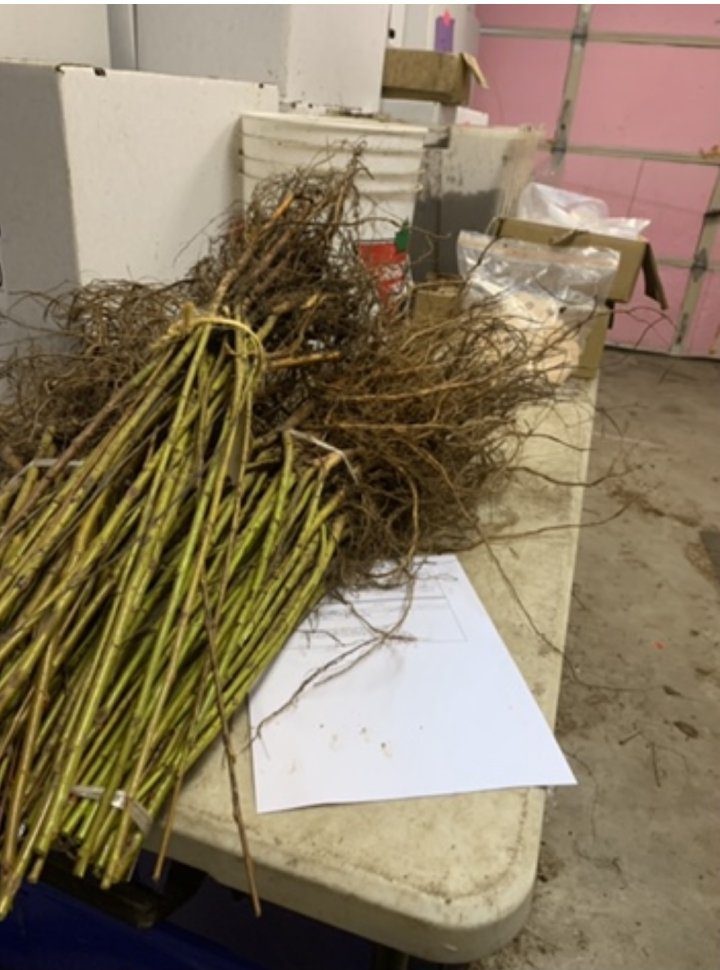
Image: Bareroot tree
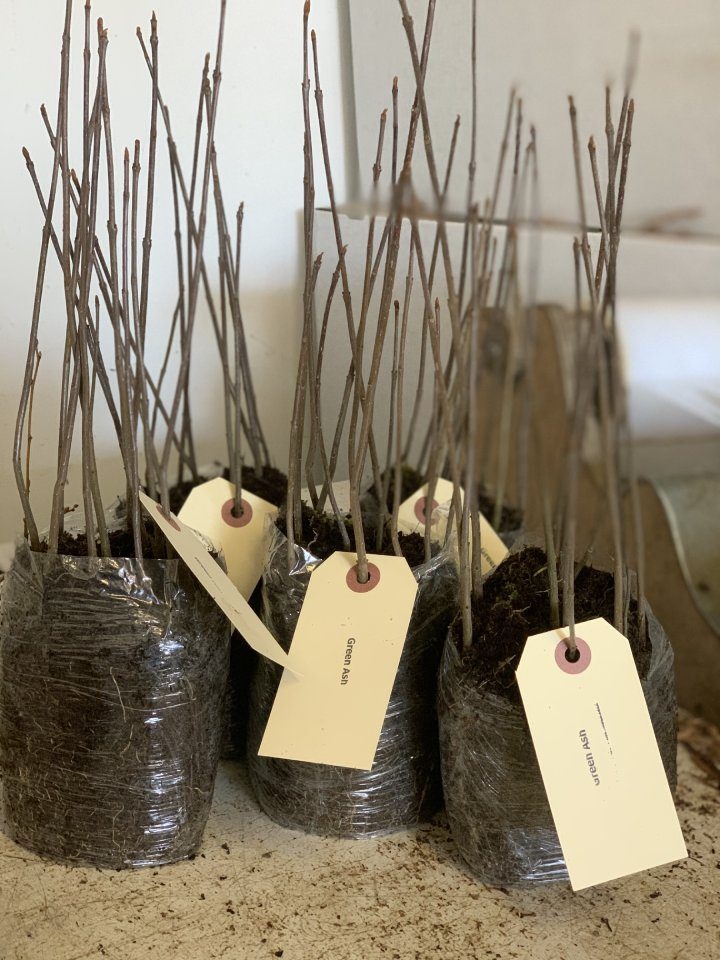
Image: Tree plugs
Potted
Typically available in 1 gallon or 2 gallon options, these tend to be a larger investment but the benefits may outweigh the costs. A large root system that doesn't dry out as quickly, but still requires regular watering. Additionally, a larger initial plant more easily seen preventing accidental mowing, etc. Typically, shipped actively growing.
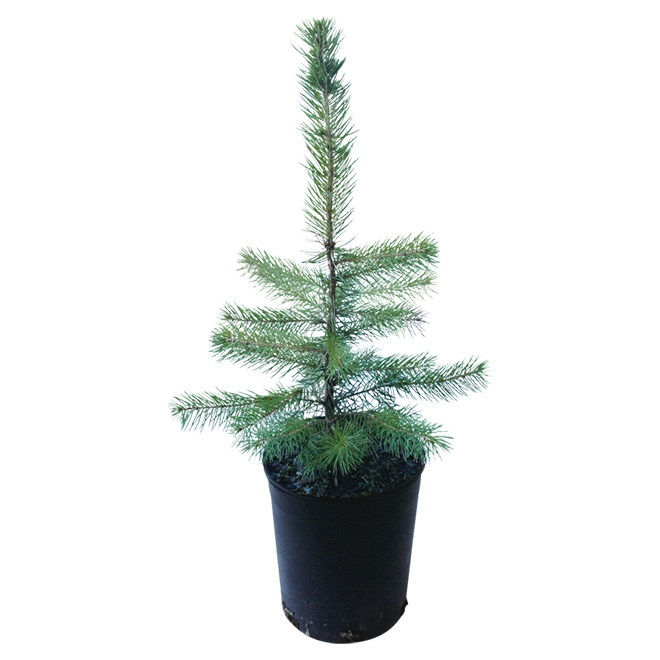
Image: 1 Gallon Potted Spruce
In our experience, home owners typically have more success with potted over bare root or plugs.
3) Planting - Spacing between plants within Rows
Spacing recommendations between trees and shrubs, as well as between shelterbelt rows, varies according to theplanting type. For example a columnar swedish aspen or tower poplar can be planted a lot closer than say a silver leaf willow.
It takes longer for trees to form an effective wind barrier at wider spacing. This can be overcome by staggering the trees in adjacent rows. The delay in effectiveness will be more than offset by the increased growth and vigour of the trees that have adequate space to grow. Well spaced trees live longer, retain
their lower limbs better and produce more foliage.
A well-designed shelterbelt reduces wind velocity but still allows a breeze for ventilation. If a shelterbelt is planted without allowing air flow for ventilation, the summer conditions within the farmyard may be uncomfortably hot.
Symptoms of an overcrowded shelterbelt are a slowing of growth in height, dead lower branches, and a reduced trunk diameter. Under severe crowding conditions the trees will die at an early age, mainly from lack of moisture. Trees whose vigor has been reduced are prime targets for insect and disease attacks.
4) Planting - Spacing between rows
Shelterbelts with both deciduous and coniferous species must have adequate space. If deciduous and coniferous tree rows are planted too close together, the faster growing deciduous trees soon overtake the conifers in height. When this happens, the conifers become shaded resulting in deformed growth,
stunting and reduced effectiveness. To avoid problems, leave the recommended minimum 6 m (20 ft.) spacing between rows of deciduous and coniferous species. All other between-row spacing should be 5 m (16 ft.) Spacing within-row depends on the species. (source: Alberta Agriculture)
Depending upon where you research, different sources have different recommendations and the spacing will depend upon what is planted.
Contact us for detailed spacing requirements. Call us at 403-741-8196.
Summary
Remember! There are no rules, and creativity is encouraged! With fall colors, flowering plants, and using different plant materials, an artful palette can be easily created for your enjoyment for years to come.
Alberta Agriculture and Agri-Food Canada has released a design guideline for Shelterbelts that is comprehensive and very informative. Find it here: Shelterbelt Design Guidelines